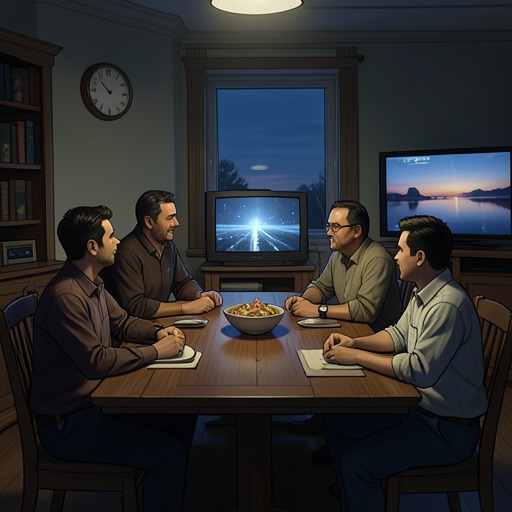
The Keskin household’s timeless world
The Museum of InnocenceThe Keskin household’s timeless world is the shared domestic rhythm Kemal enters through years of suppers with Füsun and her family in Çukurcuma. Its defining pattern is repetition without simple sameness: familiar meals, television programs, silences, and a wall clock that may or may not be running make a private present in which each visit can feel enduring. That refuge never wholly escapes public time, however. Broadcast schedules, the state’s signals, and the curfew imposed after the 1980 coup repeatedly reveal the outside world pressing against the household’s routines.
The Household as a Private Realm
Kemal’s regular visits began on October 23, 1976, eleven days after Nesibe’s open-ended welcome, and continued until August 26, 1984. Across 409 weeks and 2,864 intervening days, he went to supper 1,593 times—an average of roughly four visits a week, though the actual pattern varied. Some weeks he saw the family every day; in others, wounded pride led him to stay away. Yet he never remained absent for more than ten days, because separation brought back the misery he had experienced in the autumn of 1975. The Keskin family came to expect him and kept a place for him at the table without needing to issue another invitation.
That settled welcome did not immediately make Kemal comfortable. During his first visits, he worried that another arrival might impose on the family, while staying away might offend them or deprive him of the chance to see Füsun. He was still learning the house’s routines and how to inhabit Füsun’s presence. They were rarely alone, so their closeness often had to pass through glances and brief whispered expressions of how much he had missed her. The household’s ordinary hospitality gave their unspoken attachment a place to continue, while also keeping it within the bounds of family life.
The visits acquired an agreed, less troubling description: Kemal went to the Keskin home to sit. The word softened the difficulty of naming why he came. He usually arrived around seven in the evening and left after the nightly broadcast closed, often near midnight; he estimated that a visit lasted about five hours. His own shame encouraged him to imagine that he had gone home earlier than he had. The repeated schedule transformed an intense private longing into an almost customary part of the household’s evenings.
The Clock and Competing Kinds of Time
The German-made clock beside the door, enclosed in wood and glass and fitted with a pendulum and chime, stood as a reminder of continuity and of the official world beyond the home. It was not a dependable instrument for organizing the family’s day. Television had largely taken over that function, and the clock’s status reflected a wider change in Istanbul: wall clocks had once marked Westernized domestic aspiration, but wristwatches, radio, and later television made them increasingly unnecessary for telling the hour.
In the Keskin home, the clock might tick, stop, or remain silent while its mechanism ran. The family could forget it for weeks, then hear it chime during a lull in the television. Nesibe might turn toward it, and Tarık might wonder who had wound it. A pendulum could be stopped with a finger; sometimes Füsun would smile at her father, leaving him to decide whether she should intervene. The uncertainty became a recurring source of teasing and minor domestic discord. Nesibe resented being woken by the chime, while Tarık defended its presence as a sign that the house was still a house. Their dispute gave the clock a social role beyond measuring hours: its intermittent sounds repeatedly brought the family’s shared habits into focus.
Television, by contrast, supplied the household’s practical time. Before the evening news on TRT, a large clock appeared on screen. Füsun checked her wristwatch against it, while Tarık consulted one of the pocket watches he used over the years. Kemal watched Füsun concentrate on setting her watch and noticed that she knew he enjoyed seeing her do it. The small repeated exchange linked a public signal to a private understanding: the screen established a common hour, while her glance and smile made the ritual theirs.
Official Time, Domestic Rhythm, and Interruption
For Kemal, the clock on television connected the Keskin household to families across the country and to the state. The news schedule, the broadcast-day ending, and the call to prayer belonged to a public system of time; checking a clock or calendar helped people coordinate with one another and with society. By contrast, the family’s untidy domestic life seemed to occupy a realm of its own. When the national anthem and flag appeared at the close of broadcasting, the scale of the nation became briefly palpable, set against the intimate disorder of supper at the Keskin table.
The difference is not simply between a working clock and a stopped one. Kemal interprets it as a difference between linear time, which links one present moment to another and eventually makes change and death unavoidable, and the particular moments that can be remembered for their own fullness. Drawing on Aristotle’s distinction between Time and indivisible present moments, he argues that people cannot truly forget time, but can sometimes find happiness by attending to the moment rather than its place in a life-long sequence. The wall clock’s paradoxical service is to help the family forget time while making the present feel continuous and familiar.
That private rhythm was vulnerable to political events. In September 1980, four years into Kemal’s visits, a military coup brought martial law and a ten o’clock curfew. He then had to leave at a quarter to ten, before his longing to remain had been satisfied. As Çetin drove through streets emptying in the dark, the shortfall of each visit became sharply apparent. The curfew did more than alter a schedule: it imposed official time directly on the intimate routine, forcing Kemal to measure a supper evening against a deadline he could not ignore.
Repetition, Memory, and the Meaning of Happiness
The household’s timelessness does not mean that nothing happens there. Its evenings contain films, quiz shows, weather reports, news, and the ordinary work of serving supper. Füsun moves between the kitchen and the dining area with plates and pots, sometimes crossing Kemal’s view of the television; he experiences her passage not as an obstruction but as the center of his attention. Other evenings contain long stretches of silence, a car passing noisily down the hill, rain at the window, or Nesibe forgetting a cigarette in the ashtray and lighting another in the kitchen. Someone might add coal to the stove; Füsun might yawn; Kemal might lose track of a film or consider bringing her a bracelet instead of a hair clip. The accumulating, sometimes trivial actions are what make the repeated evenings particular.
The chapter’s measured recurrence of “Sometimes” formally echoes that domestic life. Instead of presenting the years as a succession of major events, it gathers passing gestures and household sounds into a sequence that can be revisited. Television programs that the family half-watches, interruptions from outside, and stretches of shared quiet all become part of the remembered scene. Repetition therefore does not erase detail. It gives small details a place in a pattern, allowing the ordinary evening to carry emotional weight without becoming extraordinary in outward appearance.
Kemal later understands that he went not only to see Füsun but also to inhabit, for a while, the world whose air she breathed. He connects that experience to the broken, rusting clocks and watches in his museum: objects that no longer reliably mark the hour seem to belong to a time of their own. He also explains that he took home objects Füsun had touched in order to preserve the happiness of those visits. Each object could bring back a distinct moment, and together the objects could summon the fuller reality of sitting at the dinner table with Füsun and her family.
The scale of the visits thus changes in retrospect. What could look like an eight-year obsession measured by thousands of days becomes, in Kemal’s later account, 1,593 evenings at the table, each recoverable as a moment rather than merely a point on a line ending in loss. He remembers even the difficult, hopeless, and humiliating evenings as happiness. The Keskin household’s private time cannot abolish change, but its repeated rituals—supper, television, the uncertain clock, and the familiar company—allow Kemal to preserve moments that official time would otherwise carry away.